After the camera, the thing that is the heart of photography is the camera lens.
The lens is the thing that controls how your image looks.
It controls how much of a scene you capture, what you capture it and how your subject appears.
If you change a lens, it can change the perspective, emotion, and focus in a way.
Understanding and choosing the right lens can affect the perspective depth and the emotion of a photograph.
The right lens can help a photographer achieve their ideas and make them a reality.
Hence, the lens choice matters, some might say more than the camera itself.
Before we start, if you’re new to photography then checkout our latest guide on Complete Photography Setup Guide for Beginners in India 2026.
Overview of Main Camera Lens Types
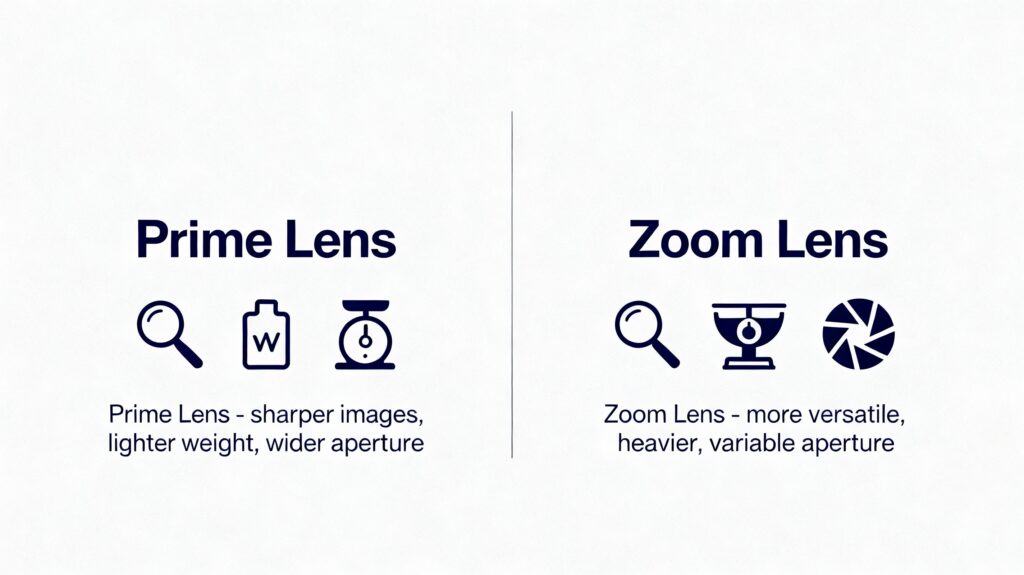
Each camera lens offers a different type of visual effect or serves a particular type of photography.
Prime lenses are used to produce sharp and high-quality images as they have a single focal length.
Whereas the zoom lens offers versatility with multiple focal lengths in a single lens.
Key Differences Between Camera Lens Types
Wide-angle lenses, as the name suggests, capture a vast scene; standard lenses capture the one closest to the human perspective.
Telephoto lenses bring far objects closer, and macro lenses focus on the tiniest detail.
There are various specialty lenses as well, such as fisheye or tilt-shift, which can create artistic effects.
Wide-Angle Lenses: Features & Uses
Wide-angle lenses have shorter focal lengths, mostly below 35mm, which gives them a broad field of view.
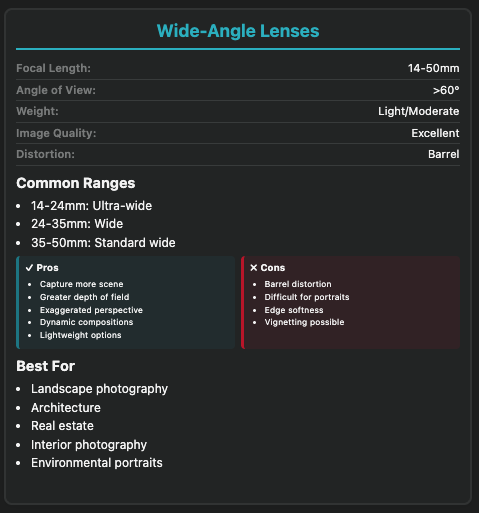
These lenses also give a feeling of depth in the images as they make the objects in the foreground appear longer than the background.
It keeps most of the image in sharp focus, but there can be some distortion on the edges.
Now let’s talk about the best uses of wide-angle lenses.
Best Uses Of Wide-Angle Lenses: Landscapes, Architecture, Group Shots
Wide-angle lenses are ideal for landscape shots as they capture skies, mountains, and open areas in a single frame.
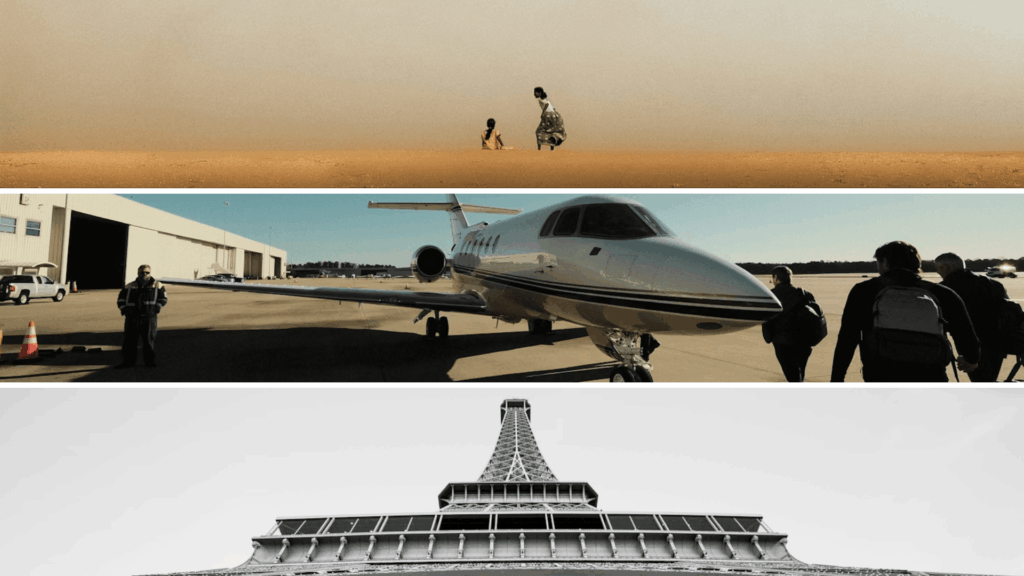
These lenses are also used in architectural photography as they can fit the buildings and the interior in a single shot.
It also works well for group shots as it allows the photographer to capture a shot that includes a large number of people.
Telephoto Lenses: Features & Uses
Telephoto lenses are the lenses that have longer focal lengths, generally ranging from 70mm or 600mm or even more.
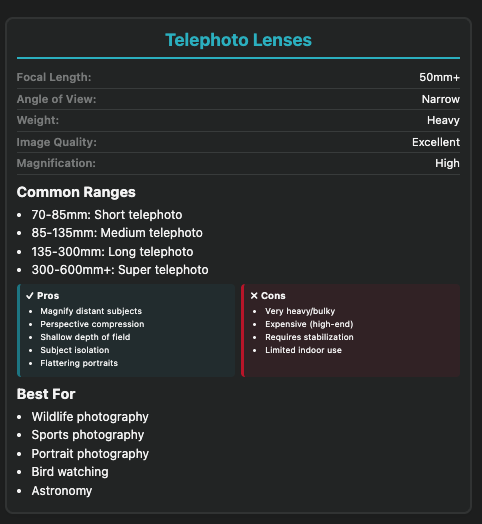
This longer focal length allows photographers to capture subjects that are far, and that too with great clarity.
It magnifies the distant scenes and compresses the perspective, which makes the background appear closer.
These lenses are quite heavy and require a steady hand or a tripod to get a sharp image.
Best Uses of Telephoto Lenses: Wildlife, Sports, Portraits
Telephoto lenses are most widely used in wildlife photography since it is not possible to get close to animals.

Hence, these lenses allow for zooming and capturing them.
Another use of these lenses is sports photography, as they can quite efficiently freeze the action across the field.
These are also great for portraits, they can help create various effects such as hokey and others.
Prime Lenses: Fixed Focal Length Guide
Prime lenses are the lenses that have a fixed focal length, and they cannot be zoomed in or out.
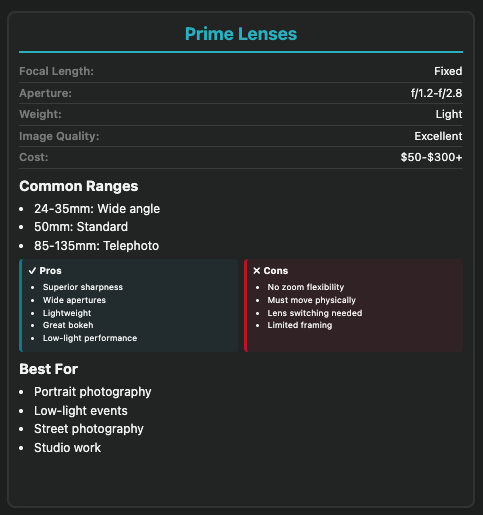
So with this lens, it depends on the photographer to move closer or farther from the subject.
This lens is made for a specific focal length and hence it offers superior optical performance.
Advantages of Prime Lenses: Sharpness, Aperture, Weight
Prime lenses are specialised lenses and hence they offer exceptional sharpness and have a high image quality.

These lenses are smaller and lighter, making it easier to carry them.
It has a wide aperture ranging from f/1.8 or f/1.4.
This aperture allows the lens to capture well in low light conditions and even helps create creative effects such as bokeh.
Popular Prime Lens Options (35mm, 50mm, etc.)
Two of the most popular and most used prime lenses have focal lengths of 35mm and 50mm.
The 35mm lens offers a wider field of view, which is great for environmental or everyday scenes.
On the other hand, the 50 mm lens allows for a more human vision and works best for a natural perspective.
Zoom Lenses: Versatility Explained
Zoom lenses are the opposite of prime lenses; they have a variable focal length.
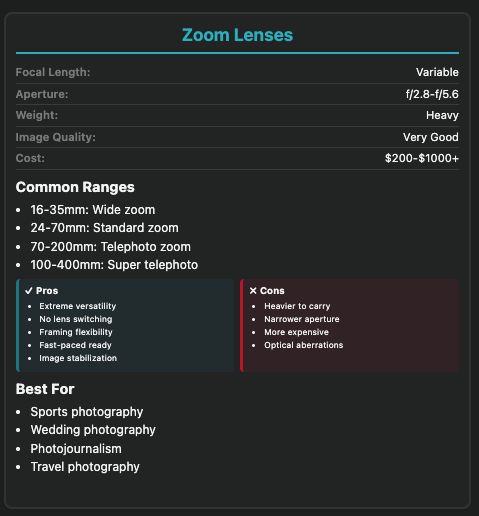
This makes them versatile, and they can be used for various purposes, from wide-angle to telephoto lenses.
Some of the most commonly used zoom lenses are 18-55mm, 24-70mm, and 70-200mm lenses.
Variable Focal Length Benefits & Trade-Offs
Using zoom lenses, there can be quick framing adjustments made.
These adjustments are perfect for the convenience and for situations where changing the position or the lenses isn’t practical.
Even though there can be adjustments in the focal lengths then too it manages to maintain the image quality.
Many zoom lenses even have image stabilisation to reduce the blur when handheld.
Popular Zoom Lens Ranges (18-55mm, 70-300mm)
Some of the most popular zoom lenses range includes 24-70mm for everyday photography.
Another one is the 16-35mm, which is used for wide wide-angle zoom suitable for landscapes, interiors, etc.
The 70-200mm lens is another choice that is used as a telephoto lens and for wildlife and portraits as well.
Now that we are familiar with the different types of lenses, let’s see how to choose the right lens for you.
How to Choose the Right Camera Lens
Choosing the right lens is an important matter; it can impact your photography, your motivation to work, and everything.
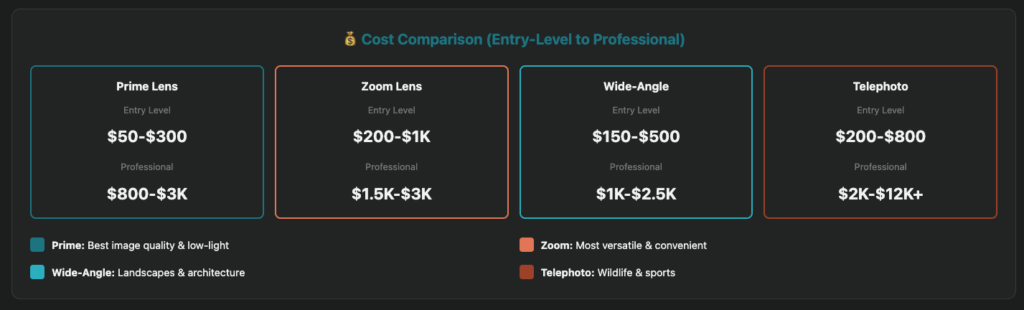
Match Lens Type to Your Photography Style
The first and foremost thing you need to consider while choosing a lens is your photography style.
Consider the style of photography you most often capture, such as portraits, landscapes, wildlife, close-up, or sports.
Your photography style can help a lot in choosing the lens, like portrait and street photographers prefer 35-50mm prime lenses for sharpness.
Landscape and travel photographers use wide-angle lenses.
Now, after seeing which lens is best suited for your preferred photography style, the next step is the budget.
Budget-Friendly Lens Options in India (2026)
Budget and brand choice are the next major factors for lenses.
For beginners, the best choice can be 50mm f/1.8 or f/2.8.
You also need to make sure that the lenses mount with the camera brands such as Canon, Nikon, Sony, etc.
Also, confirm that it fits your camera’s sensor size.
If you’re running under low budget and want some quality lens then checkout our guide on Best Photography Lenses for Beginners India 2026: Complete ₹5K-₹20K Guide.
Key Factors: Aperture, Weight, Compatibility
Beyond budget and brands, there are a few other factors you can pay attention to, such as aperture, size, and compatibility.
Now, a wide aperture means it lets in more light, but they are also costly.
If you are a travel photographer, you need your lenses to be light and small.
Some of the most asked questions about the choice of lenses are answered below.
Camera Lens FAQs for Beginners
In this FAQ section, we’ll answer common questions about different camera lens types such as wide-angle, telephoto, prime, and zoom lenses.
You’ll learn how each lens functions, its best uses, and key features like focal length and aperture.
What Lens is Best for Beginners?
The best choice for beginners, as mentioned above, is a 50mm f/1.8 prime lens. It checks all the boxes, it is budget-friendly, lightweight, and gives sharp results.
Still Confused? Check out our latest guide on Photography Equipment Checklist for Beginners: From ₹30K To ₹1.5L to find the equipment that suits your budget.
Can I Use Zoom and Prime Lenses Together?
Yes, it depends on you. Many photographers use both zoom and prime lenses.
Both are used for different purposes and for different creative needs.
How Does Lens Choice Affect Image Quality?
The lens determines how sharp, bright, and vibrant your photos appear.
A good lens can impact your images more than anything.
Do All Cameras Work With All Lenses?
No, every brand uses a specific mount type, and only some lenses are compatible with different types of mounts.
Conclusion: Finding Your Perfect Camera Lens
A lens can be an integral part of bringing your artistic vision to life.
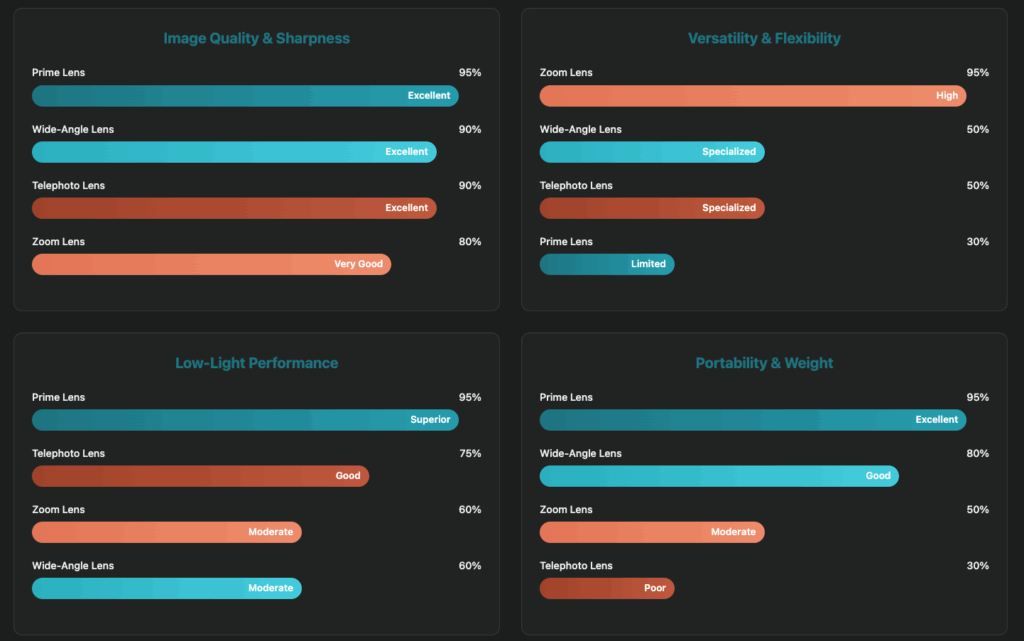
As discussed in the article above, every lens has a different purpose and effect, hence you need to choose accordingly.
You can choose the best lenses by understanding your photography style, budget, and other factors.
Just keep in mind that the right lens can make an ordinary moment an extraordinary memory.
Read more
- Ways To Earn Money From YouTube In India | Under 6 Months*
- Simple Tips For Beginners To Improve Street Photography In India
- 7 Best Cameras Under ₹50000 in India | Top Picks Of 2026
- How to Choose Your First Camera in India | Beginner’s Guide
- Camera vs Smartphone Photography: Buyer’s Guide for India 2026
